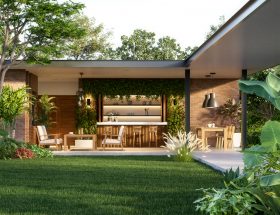
For the last couple of years, the need for privacy while in the garden has become more important due to the increase of people working from home and spending that time in their garden offices or using their outdoor seating areas. There is hardly anything more uncomfortable then when neighbors stare into your space while your trying to relax. Having the right screening solution can greatly increase how comfortable you become using your outdoor rooms or pergolas.
Why Plants Beat Fencing
The most obvious solution would be to put up a Wooden Fence, however, that is not always the best solution. For one, a solid fence winds up making sitting areas more uncomfortable and is not very effective at blocking wind. Plants, however, do a good job of filtering the wind making those spaces a lot more pleasant.
Then, of course, there is the maintenance issue. Fencing has to be regularly treated to upkeep the quality, stormy weather leads to lots of damaged panels, and they do not improve in quality over time. A mature hedge, or other types of screening plants, however, get better as time passes.Also, plants allow for customisability when creating outdoor privacy. Being able to adjust the height and deensity of privacy dividers makes for customisable outdoor spaces. For example, sometimes all that’s needed is to block a lonely window or unappealing view, rather than putting up a full wall.
Fast Growing Evergreen Plants
Most people looking for privacy hedging plants want them to grow pretty quickly. Nobody wants to lool at the neighbor’s shed for five years waiting for a hedge to grow.
Bamboo is the fastest growing plant, however, this comes with a warning. Clumping bamboos, such as Fargesia, stay compact and won’t take over the garden, however running bamboos such as Phyllostachys can take over an entire garden. With running bamboos, it is a high maintenance plant, so unless you enjoy spending your weekends removing unwanted bamboo shoots, you might want to avoid Phyllostachys and go with Fargesia instead.
Another great option is Portuguese laurel. It grows quickly, looks smart all year round, and has small, neat leaves. It grows to a mature height of around 4-5 meters, and tolerates a wide range of soil types. If you find it gets too big, it recovers well from pruning.
Photinia ‘Red Robin’ is chosen by many homeowners as it is fast-growing, visually appealing, and the new leaves are a bright red color. This plant needs to be trimmed a few times a year, but it’s pretty easy to manage.
Slow and Steady Wins the Race
If you have a little more time to wait, the yew is a wonderful option for a screen. Though it is a little bit slower than the laurel, the lush evergreen foliage is better for blocking light and sound. Yew trees are extremely long-living and yew hedges in the UK are hundreds of years old. They only need to be trimmed about once a year, but it is a good amount of effort to do.
If you want something long-term that will act as a good security screen as well, holly is a great option. The spiny leaves help block the view and the shrubs will also keep away cats. Variegated varities, such as ‘Golden King’ are a good option if you want something that has a less dull appearance than dark green holly.
Using Climbers for Screening
The ideal climbers span height quickly and take up less ground space. Perfect for small gardens. If a fence or trellis is already a part of the landscape, they green the area up quickly.
Ivy is evergreen and a wonderful fast-growing fence. But some gardens may have pulling or brittle pointing issues, so it’s best not planted for buildings or wood sided structures. But it is harmless on a fence.
Evergreen clematis, such as Clematis armandii, is a winter flowering variety that’s scent rich in early spring. They also have a leaf retention. Just keep in mind they can get pretty large and will need a sizeable support structured.
Combining Plants with Structures
For garden rooms and pergolas, more architectural fencing is usually a design consideration. Bamboos in
planters can add this architectural in addition to being tall. So can pleached trees, which, along with bifurcated trunks, have trained canopies. While pleached trees can be more expensive, beech, hornbeam, and lime are common species used.
Grasses like Miscanthus create natural-looking screens that block out views. They die back in winter but the remaining stems still provide some screening until you cut them back in spring.
The key with screening is knowing what you actually need to block. Sometimes a strategically placed tree or tall shrub is enough to block out one particular sight line and you don’t need to screen the entire boundary. Consider where people sit and what they can see from that position and screen accordingly. It’s more effective, and costs less, than creating privacy everywhere.